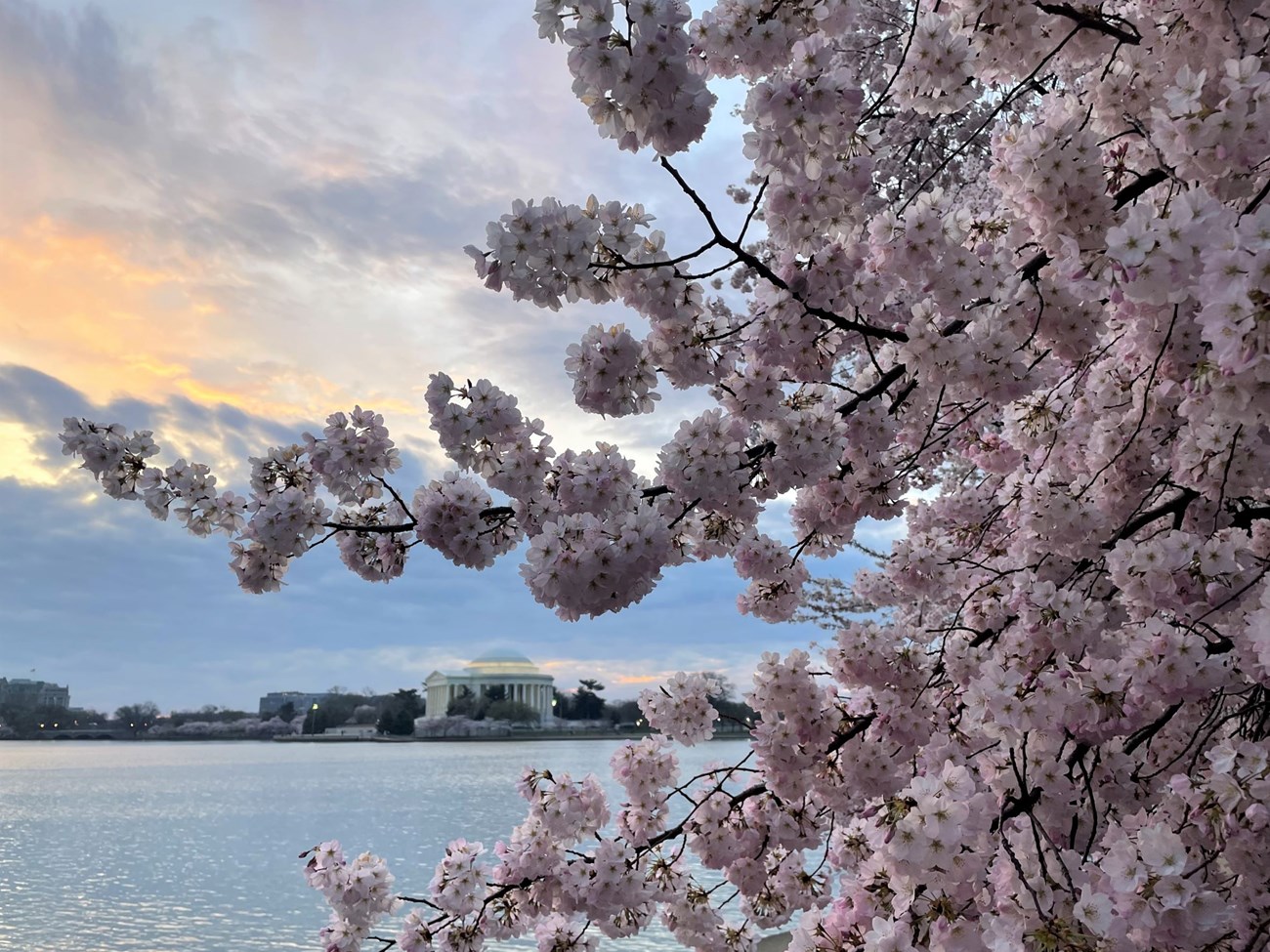
Every spring, Washington DC runs on a date nobody can give you in November. Peak bloom, the day 70 percent of the Yoshino cherry blossoms around the Tidal Basin are open, is called by the National Park Service a few weeks out and revised as the buds report in. The Park Service itself says forecasting is almost impossible more than 10 days in advance. A hotel booked in January is therefore a bet, and this page is the tracker that manages the bet: the official prediction the day it lands, the six bloom stages as the park calls them, the verified record of what the date has actually done, and the basin worked out as a route.
The honest status for 2027, stated plainly: the NPS prediction has not been announced, and it will not exist until late February or early March 2027. Any page naming a 2027 peak date today is guessing. What exists now is the pattern: the festival has bracketed the likely window, the last four predictions show how far and which way the date moves, and the long record says the bloom is trending earlier. This page carries those until the announcement, then switches to tracking the season week by week in the update log.
The forecast
The 2027 prediction: not announced yet
2027 prediction · Not yet announced Expected · Late Feb to early Mar 2027
The National Park Service announces its first peak bloom prediction at the start of the season, at a festival press event built for the purpose: on February 27 in 2025 and on March 5 in 2026. It is a window, usually four days, and it is provisional. The Park Service revises it as its horticulturists read the buds, and treats anything beyond 10 days out as an informed estimate rather than a promise. When the 2027 window is announced, it goes on this page the same day, with the announcement date stamped next to it, and every revision after it is logged below the original so the movement stays visible.
The trip math does not have to wait for it. The 2027 National Cherry Blossom Festival runs March 20 to April 11, 2027, a window chosen to bracket the likely bloom, and the festival is marking its centennial season: the first celebration was held in 1927, a century ago, around the trees Japan gave the city in 1912. A stay inside the festival window with a flexible rate is the closest thing to a hedge this season offers.
How the prediction has moved in past years
The recent record is the useful part. Three of the last four predictions were roughly right or conservative; the misses both ran in the same direction, early, and both were caused by warmth arriving faster than the forecast allowed for.
| Season | NPS prediction | Actual peak | How it landed |
|---|---|---|---|
| 2026 | Mar 29 to Apr 1, announced Mar 5, 2026 | Mar 26 | Missed early. A burst of spring warmth pulled the bloom in three days before the window even opened. |
| 2025 | Mar 28 to 31, announced Feb 27, 2025 | Mar 28 | On the nose. Peak landed on the first day of the window, called four weeks out. |
| 2024 | Mar 23 to 26 | Mar 17 | Missed early. Peak arrived six days before the window, one of the earliest peaks on record. |
| 2023 | Mar 22 to 25 | Mar 23 | Inside the window, near its front edge. |
The planning lesson is not that the prediction is unreliable; it is that its errors have a direction. A warm March pulls the date toward you, and it never sends it back. Book so that an early bloom still works: arrive near the front of your best guess window, keep the rate changeable, and hold the sunrise plan for whichever morning the park calls peak.
How the bloom builds
The six stages, and what each one is telling you
The Park Service tracks the Yoshino buds through six stages and posts the date each stage is reached, defined as the day 70 percent of the Tidal Basin buds arrive there. The stages are the real forecast: once the buds start reporting, the remaining distance to peak can be read off the recent seasons rather than guessed. Individual trees run ahead of and behind the official calls, so a stage date describes the basin as a whole, not every branch in it.
| Stage | What you see | What it tells you |
|---|---|---|
| 1 · Green buds | Tight green buds on bare twigs; the trees still read as winter. | The season has started. In the last four years, peak followed 15 to 28 days later, the spread set by how March behaved. |
| 2 · Florets visible | The buds swell and split, and tiny florets show at the tips. | The countdown firms up. Forecasters start talking in dates instead of weeks. |
| 3 · Extension of florets | Florets lengthen and fill out; the canopy takes on a green blush. | The sensitive stage. A warm week here is what pulled the 2024 and 2026 predictions in by days. |
| 4 · Peduncle elongation | The flower stalks lengthen, the buds open at the seams, and the first petals show. | Close now. Peak has run five to eight days after this stage in recent seasons. |
| 5 · Puffy white | Blossoms puff open in pale pink and white along the branches; the basin already looks like spring. | Peak has run two to five days after this stage in recent seasons. If you are coming, this is the call to be in the city. |
| 6 · Peak bloom | 70 percent of the Yoshino blossoms are open and the basin is one full canopy. | The day itself. The display holds for several days past it, longer in cool, calm weather, and a hard rain or wind can cut it short. |
| After peak · Petal fall | Blossoms let go; petals drift on the water and collect along the path. | Not the end. The later Kwanzan cherries around East Potomac Park bloom roughly two weeks after the Yoshinos, a second, quieter show. |
The 2027 stage tracker
This table fills in as the Park Service posts each stage on its Bloom Watch page. Until the first bud report, expected in late February or early March, every row stands open. In season, the tracker updates the day each stage is called.
| Stage | 2027 date | Status |
|---|---|---|
| 1 · Green buds | To come | Season pending |
| 2 · Florets visible | To come | Season pending |
| 3 · Extension of florets | To come | Season pending |
| 4 · Peduncle elongation | To come | Season pending |
| 5 · Puffy white | To come | Season pending |
| 6 · Peak bloom | To come | Season pending |
For scale, the 2026 season ran the full course in fifteen days: green buds on Mar 11, puffy white on Mar 22, peak on Mar 26. The 2023 season took twenty eight days over the same ground, with cold interruptions. The stages, not the calendar, set the pace.
The record
Peak bloom dates, from the NPS record
The Park Service has kept the peak record since 1921. Its long run average is April 3, but the recent decades run earlier: the average since 1990 is March 30, and the extremes frame the whole problem, March 15 in 1990 at the early end and April 18 in 1958 at the late end. The stage by stage record below is the Park Service's own bud development table, the same one this tracker extends each spring.
| Year | Green buds | Florets visible | Extension of florets | Peduncle elongation | Puffy white | Peak bloom |
|---|---|---|---|---|---|---|
| 2026 | Mar 11 | Mar 13 | Mar 16 | Mar 21 | Mar 22 | Mar 26 |
| 2025 | Mar 11 | Mar 16 | Mar 19 | Mar 20 | Mar 23 | Mar 28 |
| 2024 | Mar 2 | Mar 5 | Mar 8 | Mar 12 | Mar 15 | Mar 17 |
| 2023 | Feb 23 | Mar 1 | Mar 7 | Mar 11 | Mar 18 | Mar 23 |
| 2022 | Mar 3 | Mar 7 | Mar 14 | Mar 17 | Mar 19 | Mar 21 |
| 2021 | Mar 11 | Mar 16 | Mar 22 | Mar 24 | Mar 26 | Mar 28 |
| 2020 | Feb 28 | Mar 3 | Mar 9 | Mar 12 | Mar 16 | Mar 20 |
| 2019 | Mar 5 | Mar 17 | Mar 23 | Mar 25 | Mar 29 | Apr 1 |
| 2018 | Feb 25 | Mar 15 | Mar 26 | Mar 29 | Apr 1 | Apr 5 |
| 2017 | Feb 24 | Mar 1 | Mar 6 | Mar 8 | Mar 22* | Mar 25* |
| 2016 | Mar 8 | Mar 13 | Mar 15 | Mar 17 | Mar 22 | Mar 25 |
| 2015 | Mar 18 | Apr 1 | Apr 4 | Apr 6 | Apr 8 | Apr 10 |
*2017: a mid-March freeze destroyed about half the Yoshino blossoms. The Park Service defines that year's puffy white and peak dates by the surviving blossoms, and the table keeps its convention.
Peak dates, 2004 to 2014
| 2014 | Apr 10 | 2011 | Mar 29 | 2008 | Mar 26 |
| 2013 | Apr 9 | 2010 | Mar 31 | 2007 | Apr 1 |
| 2012 | Mar 20 | 2009 | Apr 1 | 2006 | Mar 30 |
| 2005 | Apr 9 | 2004 | Mar 31 |
- Read the spread, not the average. Since 2015 the peak has landed as early as Mar 17 and as late as Apr 10. The average describes the century; the spread is what a trip has to survive.
- The trend is earlier. The Park Service record has moved about eight days earlier across the century of record keeping, and the last decade sits visibly ahead of the long run average of Apr 3.
- Warm winters front load the season. The earliest recent seasons, 2020, 2023, 2024 and 2026, all show February or early March green buds. A mild February is the first warning this tracker watches for.
Plan for the window, not the day
Booking around a moving date
- Book the festival bracket. The festival runs Mar 20 to Apr 11, 2027, chosen to bracket the likely bloom. A stay inside that window, on a rate you can change, beats a cheaper nonrefundable stay pinned to a guessed day.
- Put the flexible day in the middle of the trip. Arrive a day or two before your best guess at peak. An early bloom then still meets you at the front of the display, and a late one gives you the run up, the festival, and the monuments while you wait.
- Keep one plan for each direction. If peak comes early, the basin is the first morning, not the third day. If it slips, the festival calendar runs regardless of the trees, and the Kwanzan cherries extend the season at the back end.
- Book the bookable layers early, on refundable terms. Guided time at the basin sells out in bloom season, and so do the river cruises. The three experiences below are the bookable layer of this tracker; reserve them on terms that let you move the day when the prediction moves.
Book ahead · The guided morning
Tidal Basin blossom tour
A guided walk of the basin loop at bloom time: the memorials, the oldest trees, and the history of the 1912 gift, with a guide who knows which stretches of path are open while the seawall work moves around the shore.
On Viator: The DC Cherry Blossom Bus Tour with Tidal Basin Guided Walk · Rated 4.6 from 161 reviews
Book ahead · The flexible day
Monuments tour, bloom season
The National Mall's memorials with the blossoms as the backdrop, the tour to hold for the day the bloom is not ready or already gone. It is the plan B that never feels like one.
On Viator: Washington DC Monuments by Moonlight Tour by Trolley · Rated 4.6 from 4,251 reviews
Book ahead · The basin from the water
Potomac blossom cruise
The Tidal Basin and the Hains Point shoreline from the river, including the festival's own blossom cruises from The Wharf and Georgetown. The canopy reads whole from the water in a way the path never quite gives you.
On Viator: City Cruises DC Scenic Buffet Lunch Cruise · Rated 4.0 from 471 reviews
If the bloom beats you anyway: petals hold on the trees for several days past peak in calm weather, and petal fall on the water is its own photograph. Two weeks later the Kwanzan trees around East Potomac Park put on the second show to a fraction of the crowd. And the season runs both ways around the planet: our Tokyo cherry blossom map tracks the same spring in Japan, where the bloom moves north city by city for weeks.
On the ground
Working the Tidal Basin
The basin loop is about two miles of path around the water, taking in the Jefferson Memorial, the Martin Luther King Jr. Memorial, and the Franklin Delano Roosevelt Memorial, under the canopies of the park's cherry trees. It is the most visited spring walk in the country, and it rewards the same discipline as a park lottery: arrive early, come on transit, and walk the far side first.
- Metro first. Smithsonian station, on the Blue, Orange and Silver lines, is the classic approach, about a fifteen minute walk to the water; L'Enfant Plaza serves the south side. The Park Service tells drivers plainly not to come at peak: parking near the basin is scarce, roads around it are restricted on the biggest days, and the walk from the platform is faster than the crawl in a car.
- Sunrise is the quiet hour. The light comes across the water, the Jefferson Memorial photographs clean, and the tour groups have not landed. Weekday mornings are next best. Weekend middays at peak are the crush, with the path at its slowest on the west side by the memorial steps.
- Walk the east side for space. The stretch from the FDR Memorial toward Hains Point carries a fraction of the crowd of the Jefferson frontage, under the same canopy.
- Check the path before you go. Sections of the basin path have been closed in recent seasons for the Tidal Basin seawall reconstruction, and the open route changes as the work moves. The Park Service posts the current state of the bloom and the paths on its Bloom Watch page; read it the night before, not last month.
- Leave the blossoms on the trees. Picking blossoms and climbing the trees are against park rules, and these are old, irreplaceable trees: the original 1912 plantings among them. Photograph everything, take nothing.
Festival dates worth a diary, 2027
- Mar 20: Opening Ceremony, and the festival opens across the city. BloomFest at the Tidal Basin, by the Jefferson Memorial, runs the full festival.
- Mar 27: the Blossom Kite Festival on the Washington Monument grounds.
- Apr 10: the National Cherry Blossom Festival Parade down Constitution Avenue.
- Mar 20 to Apr 11: the full festival window. Full programme on the National Cherry Blossom Festival site.
The running log
Season updates
Dated entries, newest first. In season this log updates at least weekly, and on the day itself whenever the Park Service moves the prediction or calls a stage.
- Nov 9, 2026: Tracker published ahead of the season. The 2027 NPS prediction has not been announced, and this page will not invent one; the record, the stage explainer and the planning math are live, and the 2027 stage table stands open. Next scheduled update: when the Park Service posts its first 2027 bud report, expected in late February.
Stage dates, peak dates and prediction windows on this page come from the National Park Service Bloom Watch page and the National Cherry Blossom Festival. The Park Service is the final word on the bloom; this page is a tracker, not the referee. Confirm festival event details on the festival site before building a day around them.
The other season
Fall gets a tracker too
The companion tracker for autumn: peak foliage windows for seven towns, from Stowe to Gatlinburg, built the same way this page is, on the historical record, with the official reports named for the live word in season and the booking layers in the order they sell out.