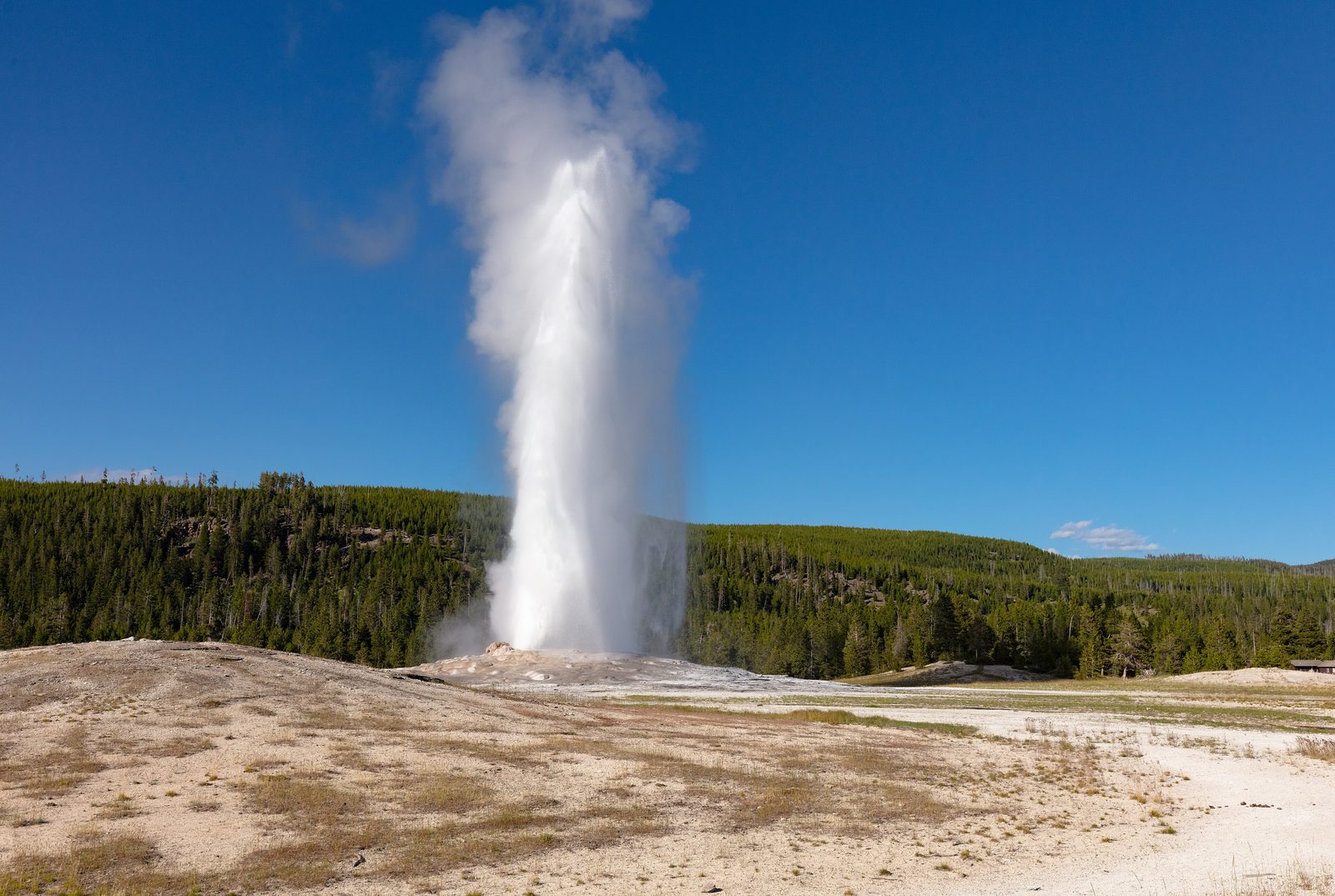
Yellowstone is roughly twice the driving of the other big parks, and most first itineraries ignore that. They sleep in one place, cross the park at dawn every day, and spend the trip looking at the Grand Loop through a windshield. This route does the opposite. It moves base three times, works one quadrant per day, and ends each day where the next one starts, so the trip never backtracks across the park.
Four days is the honest minimum for a first visit in the main season (late spring to early fall) at a moderate hiking pace: one day for the north end, one for the canyon country, one for the geyser basins, and one for the lake and the way out. This page is the Yellowstone entry in our Yellowstone and national parks guides, and everything in it, the order, the timing, the warnings, comes from our own Yellowstone planner, with fees and windows verified against the park's official pages on October 15, 2026.
The route at a glance
The route, day by day
-
Day 1
Mammoth & Lamar Valley
Terraces at first light, the northern road, Lamar Valley at dusk.
Base: Gardiner
-
Day 2
Norris & the Canyon
Norris at opening, Artist Point, Hayden Valley in the evening.
Base: Canyon / Lake
-
Day 3
Geyser basins
Grand Prismatic overlook, Midway boardwalk, Old Faithful twice.
Base: Old Faithful
-
Day 4
The lake & the way out
West Thumb, Fishing Bridge, the Mud Volcano area, then out.
Base: Onward
The map: this route, on your phone
Every itinerary on the internet describes a route. This one hands you the route itself: a curated map built from this exact plan, 40 pins in four layers. The Day Stops layer carries the 15 stops below in order, with the planner's guidance on each pin. The other layers add the hikes worth your legs (six trailheads, with distances only where the park service publishes them), five sights and pullouts, and the practical layer most itineraries skip: visitor centers, in-park fuel, gateway towns, and where cell service actually exists.
Open the Yellowstone map in Google Maps
One honest note on coverage: save the map and download the park area for offline use before you go. Inside the park, cell service is limited to a few developed areas, and a route link needs a signal the first time it opens.
What the map does not do
The map and this page are free, and they stay free. The Yellowstone Trip Planner is the layer that runs the trip once the route is settled:
- The map shows you the route. The planner turns your trip date into booking action dates with live countdowns, so the 13-month lodging window cannot slip past you.
- The map carries the stops. The workbook runs the budget and the pass breakeven on your parks and your group, not on a sample.
- This page gives you our four days. The planner's day planner is editable, so the days bend around your dates, your pace, and where you actually got a bed.
- The planner's companion sheet gives you one tap-to-drive link per day, stops in order, built to open at breakfast before the signal runs out.
Before the days: the two decisions that shape the trip
Sleep in the park if you can, and book the bed first. In-park lodging opens on a rolling 13-month window: on the 5th of each month, the same month of the following year opens, online first. Reservable campgrounds on recreation.gov book up to 6 months ahead. Old Faithful area rooms for summer can go the week their month opens. Gateway towns are the planned fallback, not the failure state: Gardiner and West Yellowstone have the most rooms, then Cody and Jackson for split trips with Grand Teton.
The gate is not the deadline. There is no timed entry system to plan around. Entry is $35 per private vehicle for 7 days ($30 motorcycle, $20 per person on foot or by bike, under 16 free). The Yellowstone annual pass is $70; America the Beautiful is $80 for US residents and $250 for nonresidents, and non-US residents age 16 and over pay an extra $100 per person per park in 2026 unless they hold an annual pass. At $35 a park, the national pass starts winning at the third park in a 12-month stretch; if more parks are on your year, run your own list through the pass break-even calculator before you buy anything.
Day 1: North end first: Mammoth and Lamar Valley
RouteMammoth Hot Springs terraces, then the northern road toward Tower Junction with a picnic, then Lamar Valley at dusk.
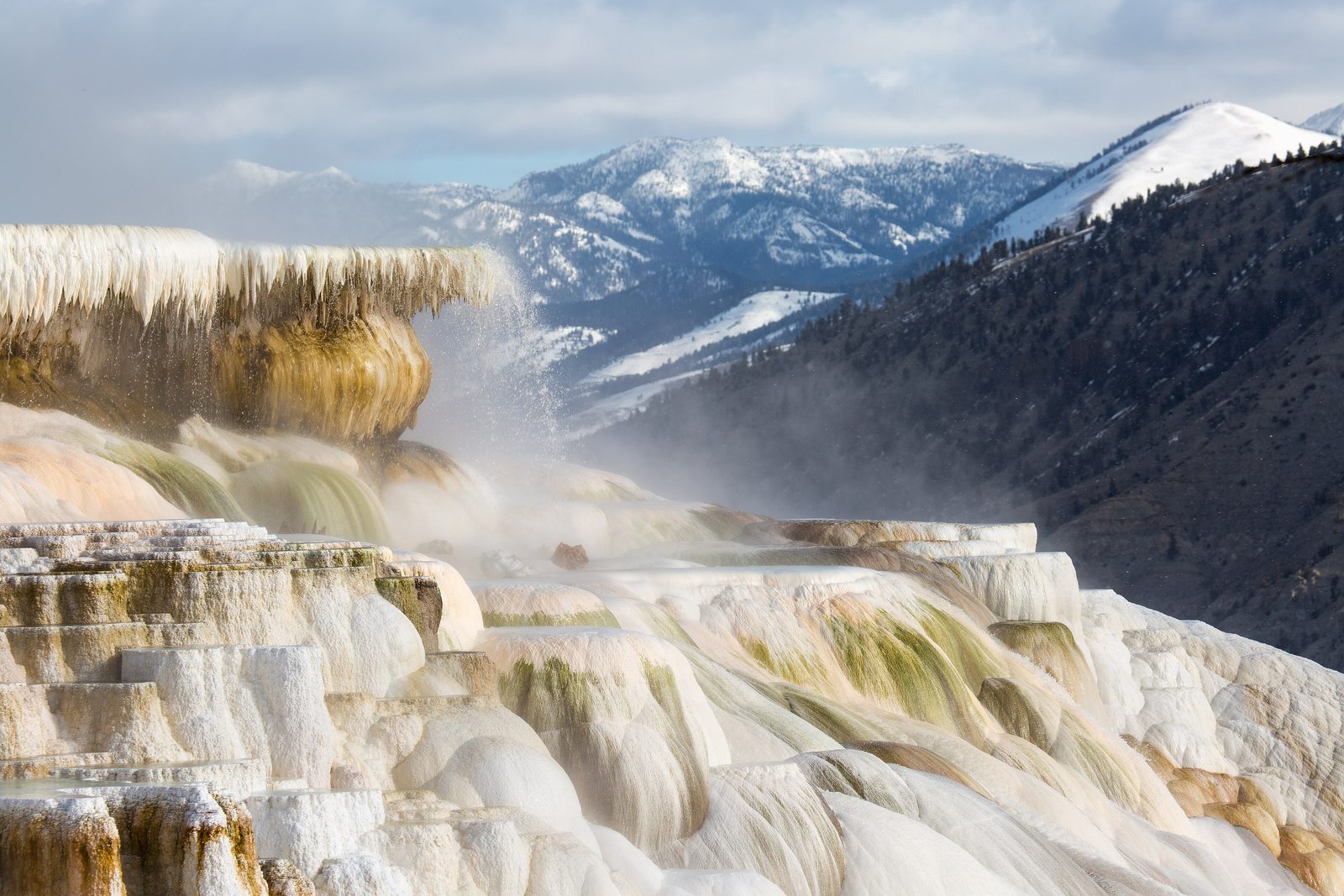
Canary Spring at Mammoth Hot Springs. Photo: National Park Service, public domain.
Morning
Mammoth Hot Springs terraces early, before the light flattens and the lots fill. The boardwalks reward the first hour of the day in a way almost nothing else in the park does, and you will share them with a fraction of the midday crowd.
Afternoon
Drive the northern road toward Tower Junction with a picnic. Stop at the pullouts that interest you rather than chasing every sign; the northern road is a corridor, not a checklist.
Evening
Lamar Valley near dusk, when wildlife moves. Pull fully off the road, stay in or beside the car, and let the valley come to you.
Base: Gardiner or the Mammoth area. This day is why the north end deserves its own nights instead of a day trip from Old Faithful. Gardiner sits at the North Entrance, the one entrance open to cars year round.
Day 2: Norris and the Canyon
RouteNorris Geyser Basin, then Artist Point and the rim viewpoints, the Brink of the Lower Falls, Canyon Village, and Hayden Valley in the evening.
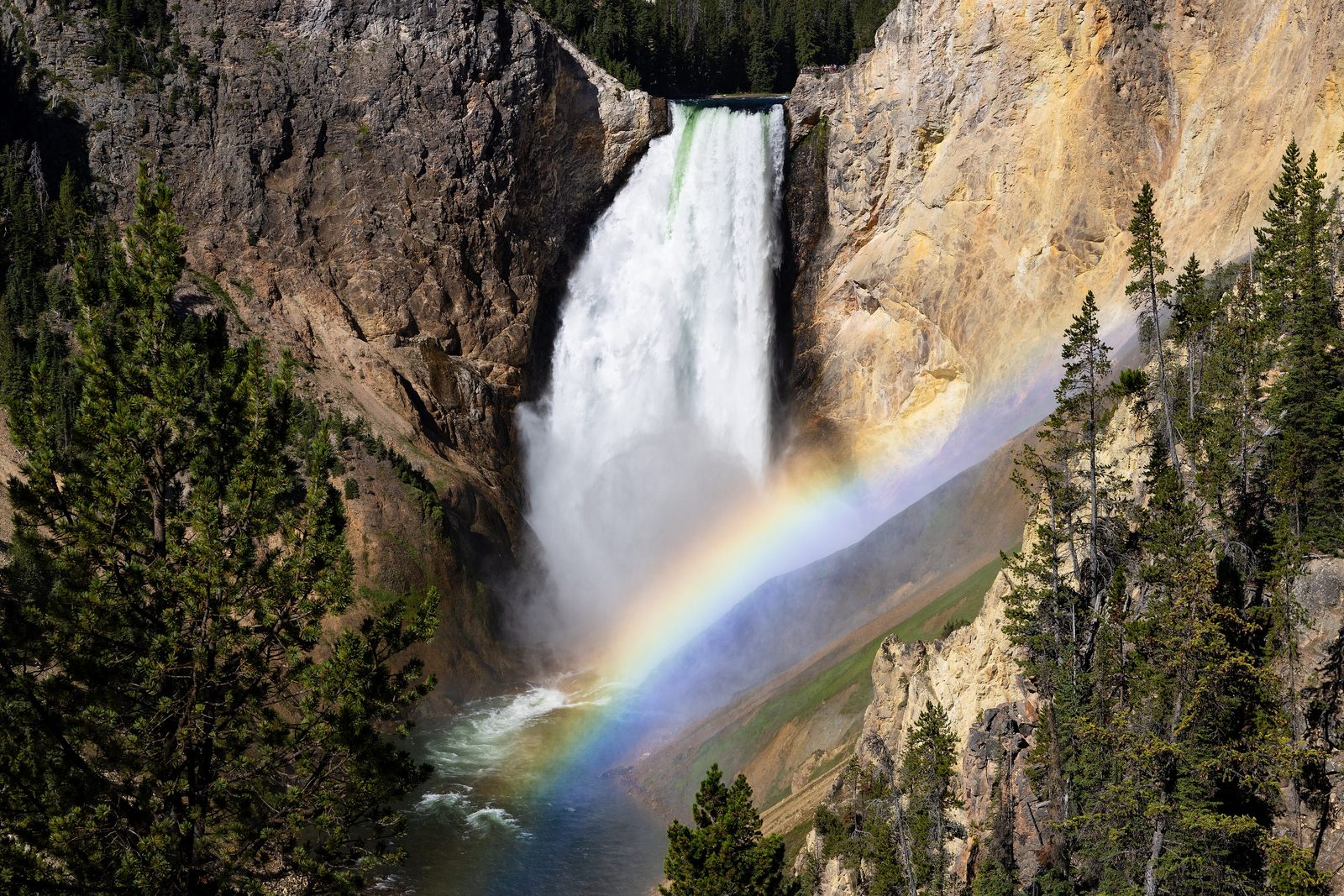
The Lower Falls from Red Rock Point. Photo: National Park Service, public domain.
Morning
Norris Geyser Basin at opening. It is the park's hottest, oldest basin, and the boardwalks are pleasanter before midday heat.
Afternoon
The Grand Canyon of the Yellowstone: Artist Point and the rim viewpoints first, then the Brink of the Lower Falls if the group has the legs for the climb back up. The order matters; the brink is the stop people talk themselves out of at 4 p.m., and it is worth not skipping.
Evening
Early dinner in Canyon Village, then Hayden Valley in evening light for one more wildlife pass.
Base: move to the Canyon or Lake area tonight, so tomorrow starts inside the park, not on the road to it.
Day 3: Old Faithful and the geyser basins
Routethe Grand Prismatic overlook from the Fairy Falls trailhead, then the Midway Geyser Basin boardwalk, then the Upper Geyser Basin and Old Faithful, with a second eruption at dusk.
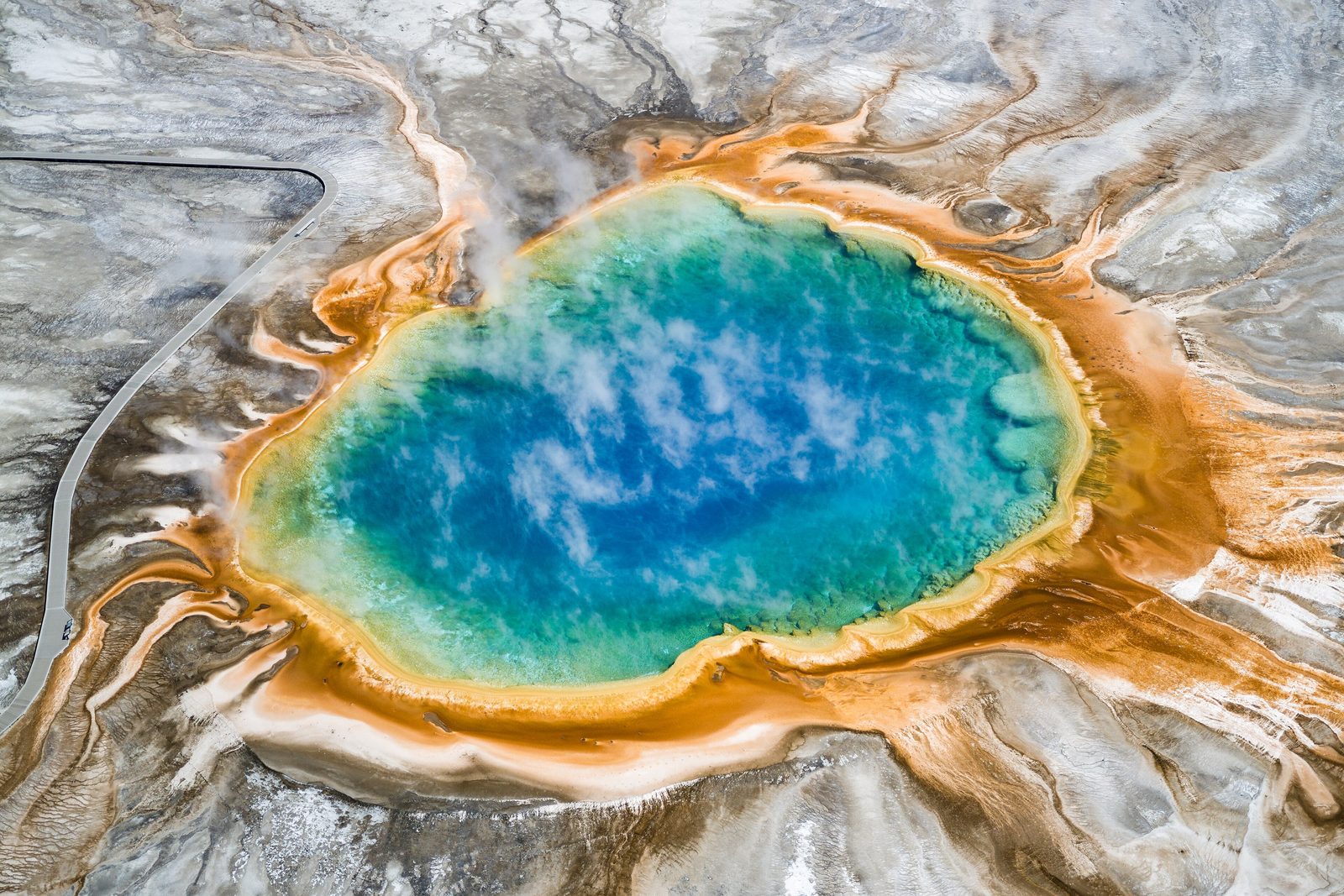
Grand Prismatic Spring from above. At ground level it is steam and color at the edges; the full picture is from the overlook. Photo: National Park Service, public domain.
Morning
Grand Prismatic Spring from the Fairy Falls overlook first, while the overlook lot is still manageable. The overlook trail is 1.2 miles there and back, climbs 105 feet, and is rated Easy by the park service; the trailhead lot sits a mile south of Midway Geyser Basin and fills early. Then walk the Midway boardwalk itself for the ground-level view.
Afternoon
Upper Geyser Basin: Old Faithful, then keep walking. Most visitors stop at the first eruption and leave the rest of the basin, dozens of features deep, nearly empty.
Evening
Check the eruption predictions posted at the Old Faithful Visitor Education Center and time dinner around a second eruption in evening light.
Base: the Old Faithful area. A predicted eruption after dinner, ten minutes from your room, is the payoff for staying in the park.
Day 4: The lake and the long way out
RouteWest Thumb Geyser Basin, then Natural Bridge or a lakeshore picnic, Fishing Bridge, and the Mud Volcano area, then out.
Morning
Yellowstone Lake at West Thumb Geyser Basin, where the hot springs meet the shore. It is the quietest of the big basins in the morning and the gentlest start to a travel day.
Afternoon
Natural Bridge or a lakeshore picnic, then start the drive out with stops at Fishing Bridge and the Mud Volcano area. If you detour to one more short trail, make it Storm Point, on the lake's north shore: a 2.3-mile loop rated Easy from the pullout at Indian Pond, 3 miles east of the Fishing Bridge Visitor Center. It can close in late spring and early summer for bear activity, so ask at the visitor center first.
Evening
Exit south for Grand Teton if the trip continues, or east and north if it does not. Do not schedule a flight the same evening from a gateway airport.
Base: onward. Park distances are deceptive: the Grand Loop is a full day of driving if you try to do it all at once, which is exactly what this plan avoids.
Season notes, briefly
PeakOpenLimited / winter
Only one road is open to cars all year: from the North Entrance at Gardiner through Mammoth and Tower Junction to the Northeast Entrance at Cooke City. In the 2026 season, west side roads opened April 17 and most roads close October 31; Dunraven Pass (Canyon to Tower Fall) and the Beartooth Highway ran May 22 to October 12; south side roads opened May 8 and east side roads May 1. Weather can close any road early or late, so check the park road page the week of the trip, not the month before. Winter is a different trip entirely, by snowcoach and snowmobile on booked tours, and this route does not cover it.
You are in grizzly country the whole four days. Food storage rules apply at every campground, and bear spray cannot go on a plane, so plan to buy or rent it after you land.
The full planner, and the map, in one place
This page is the route. The Yellowstone Trip Planner is the route plus everything around it: a workbook with the deadlines and windows as live countdowns from your trip date, the budget with the pass breakeven run on your numbers, an editable day planner, and a packing and prep checklist, with this map as its companion. It is our product, made by Summit and Spur, and this article is the honest sample of how it thinks.
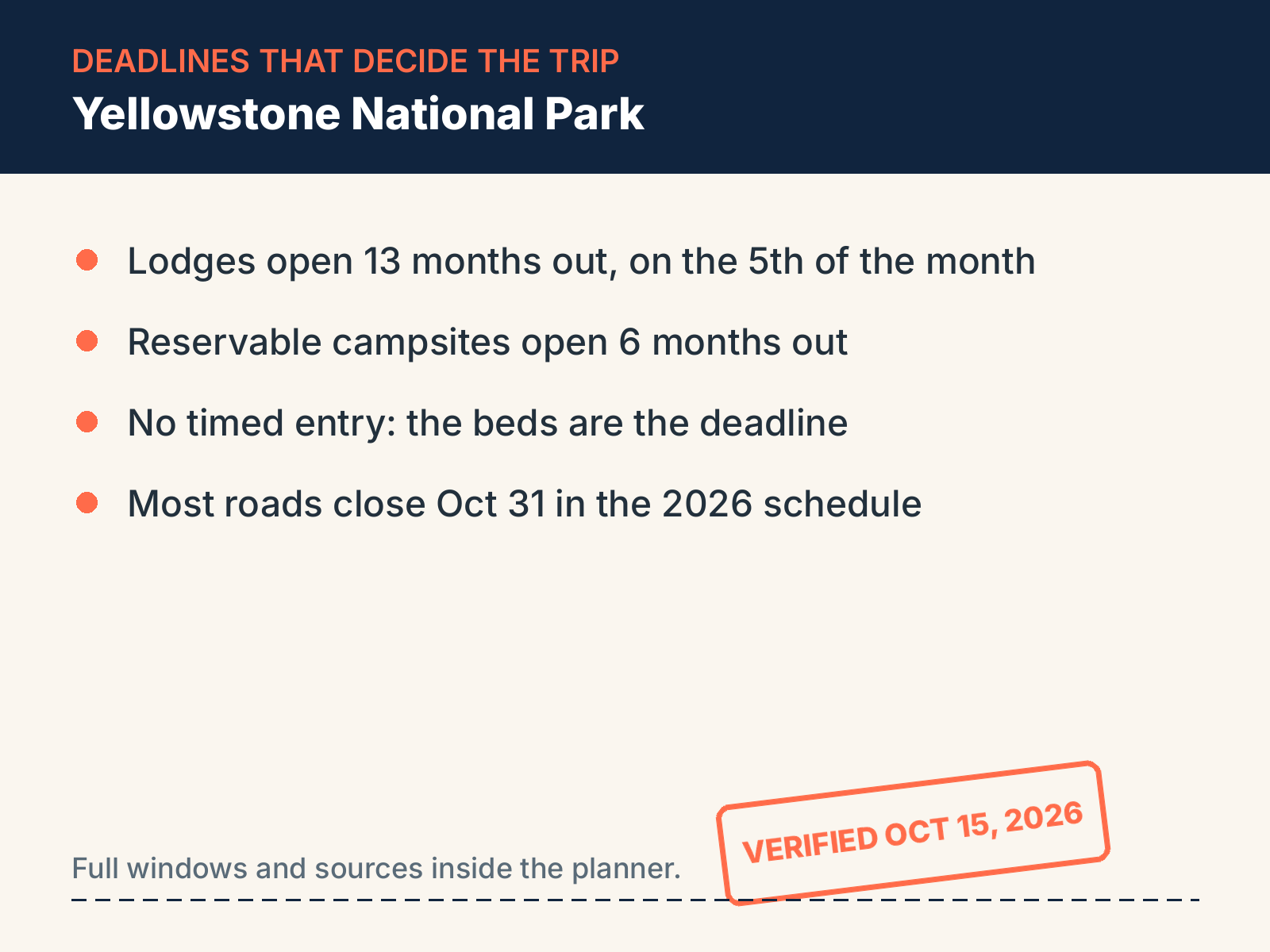
From the planner: the deadlines that decide the trip. In the workbook, each window becomes action dates with a live countdown from the trip date you enter.
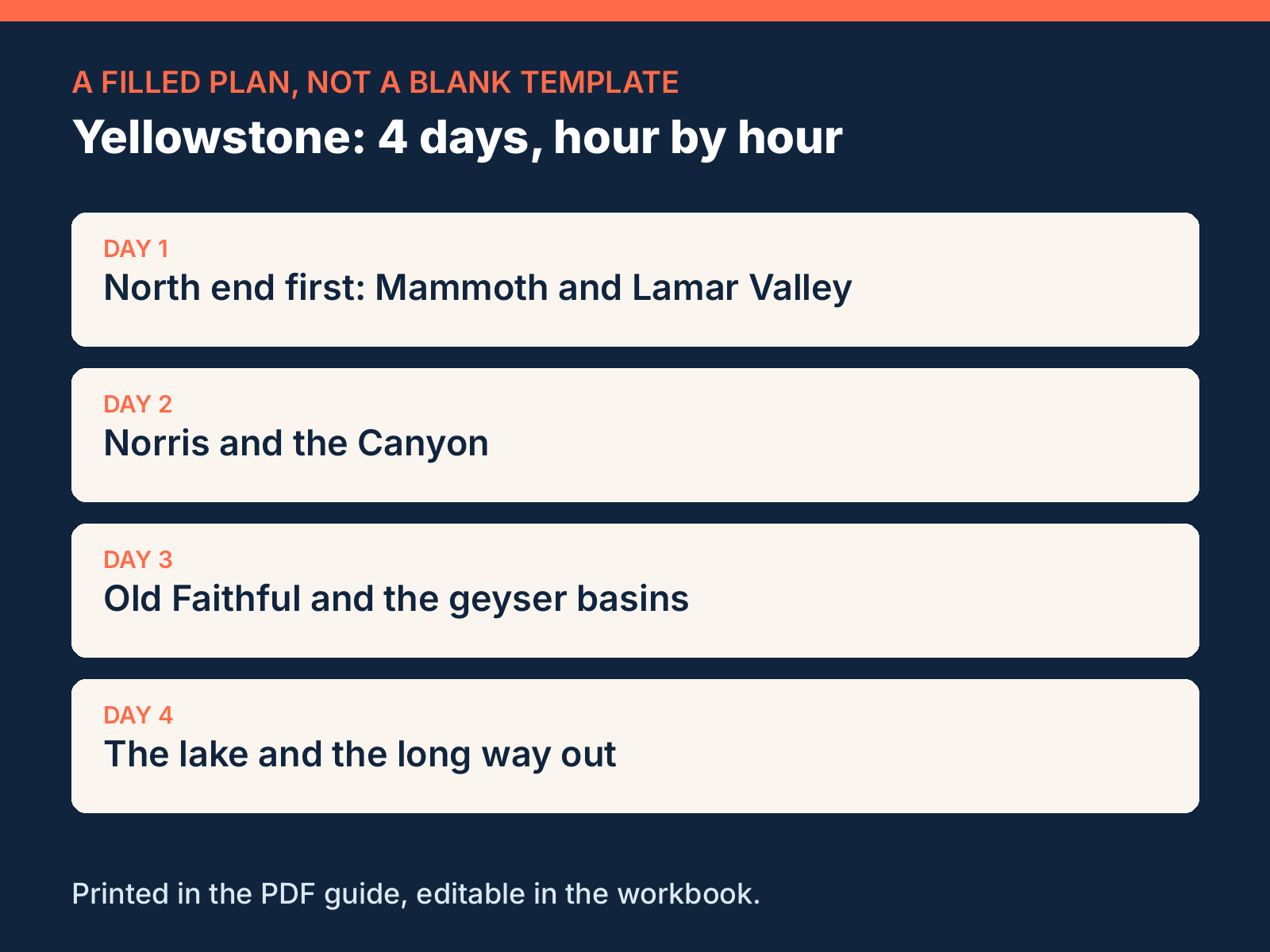
The filled four days, printed in the planner's PDF guide and editable in the workbook's day planner.
- Free on this page: the route, the map with its 40 pins, the windows and fees in prose.
- In the planner: the same trip as machinery. Countdowns from your date, the budget run on your parks and your group, days you can edit, a packing and prep checklist, and one tap-to-drive route link for each day in the companion sheet.
Get the Yellowstone Trip Planner, $7.99 Open the map
Rules verified October 15, 2026 against official park sources; 2027 rules were not yet final at that date. Confirm before booking. An independent planner from Summit and Spur, not affiliated with the National Park Service, and not a booking service. This guide is written from verified research and our planner's material; it is not a trip report.
New park planners and free tools, first.
One email when something new ships. No spam, unsubscribe anytime.